Saturday, February 7, 2015

New Schedule - Greifswald

Regular readers have noticed that this blog has been a mix of German travelogue and (plasma) physics. Also, that - at least during 2015 - I have been posting pretty regularly. In fact, for the last three weeks I've posted something every day. But this is fairly taxing, and as I return to the US, I'm going to post less, and more of the posts will be physics related. Hopefully, they will still be of general interest, because I find them interesting.

I do still have many photos from my travels to post, so those will continue (until I run out), and I plan to post only on MWF. If I feel like it, there will be some weekend posts (like this one) but I'm going to get back to the serious work of my sabbatical (exercising, thinking deeply, and research projects).

Here's one more travelogue/physics post to start off the new schedule.

Gas Metal Arc Welding

The reason I went to Berlin in January (see here, here, here and here) was to visit the Leibniz-Institute für Plasmaforschung und Technologie e.V. (INP), which is a two-hour train ride north of Berlin. One of the professors here at Hochschule München works on gas metal arc welding, among other things, and specifically investigating the parameters of the plasma arc using optical emission spectroscopy.

High resolution visible light photo of the plasma arc, taken at 1.2 ms after the current was turned on. Here, CO2 is the welding gas, and the emissions you see are from both iron (from the steel welding element) and carbon dioxide.

He was interested in getting a plasma physicist involved in this work, so after several discussions he arranged for me to spend a couple of days visiting INP and learning about the experimental and theoretical techniques that they use. My visit was extremely productive - I learned a lot - and while I was there we outlined a good project for our first collaboration. Hopefully when I get back to the US I will have some time to work on this. I'll be doing something similar to what they already do, where one of their techniques is to invert images like the one above and obtain information about the physical processes (e.g., temperature, density) as a function of position within the arc. This is a kind of "remote sensing" that reveals more information about what's going on in the arc than what you can obtain from just looking. Here, for example, is a result of one of the inversions.

Emission coefficient profiles - as functions of radial position (i.e., assuming cylindrical symmetry) - at different times and for different welding gases. Some are argon, and some are CO2.

Greifswald

Greifswald is a beautiful small university town. In fact, it has one of the oldest universities in the world. Interestingly, it's the oldest Swedish university. This is because it is located in Pomerania, which used to be a part of Sweden. I got a chance to walk around the city a bit, and one of the physicists took me to a very old church, that we were able to climb to the top and get a good view of the city. I was very taken with this church and here are some photos.
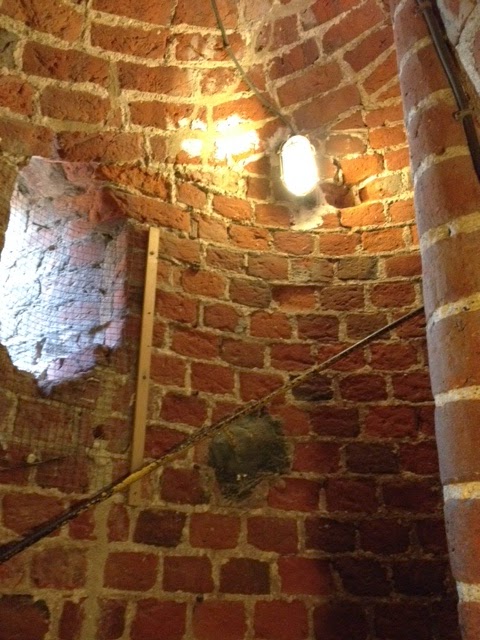
Climbing to the top of Dom St Nikolai in Greifswald.

Panoramic view of Greifswald from the top of Dom St Nikolai. If you squint, you can see the Baltic Sea in the far distance.


In this particular church, which is about 700 years old, there are people (saints, presumably) buried under the floor. I knew this was common, but this was the first time that I had seen this in Germany. There were many of these engravings on the stone floor.


The church, like most churches, had a beautiful organ. I only heard two organs playing, one in St Hedwig in Berlin, and the other at the Frauenkirche in München when we went to Christmas Eve mass.

Finally, a beautiful stained glass window. Of all the many churches that I've been to in Germany, this was one of the few that had a nice stained glass window. And this is a huge window, probably 3-4 meters tall. The photo doesn't do it justice, as usual.

Friday, February 6, 2015

3C 273

The "quasi-stellar radio source" 3C 273 and its jet. It is the 273rd object in the Third Cambridge Catalog of Radio Sources.

Fifty-two years ago yesterday, February 5, 1963, Maarten Schmidt figured out a key property of quasars, namely that it was receding from the Earth at 47,400 km/s. Assuming that this recession velocity was due to the expansion of the universe (and not that it was an object within our own Milky Way galaxy that was just moving really fast), and assuming that the Hubble constant was about 95 km/s/Mpc (today, the best value from WMAP is 71.0 ± 2.5 km/s/Mpc ), he estimated the distance to the quasar to be 500 Mpc (a parsec is the distance of an object that has a parallax of one arc second, which is about 30 million million km, or in scientific notation 3 × 10¹⁶ m), or 1.5 × 1025 m, or 15 trillion trillion meters. At the time, it was the furthest known object in the universe.

How did he do it? By realizing that the spectral lines observed in the spectrum of this star were redshifted by such an amount that no one had recognized that they were actually the spectral lines of hydrogen. In 1868, Anders Ångström had measured the wavelengths of the hydrogen lines in the visible portion of the spectrum to have the following values.
(It's amazing how accurate he was!) From Schmidt's published paper (which you can read here), he showed that there were not only the three lines in the 4000-5000 Ångström range, but also a magnesium line and a mercury line. But dividing the observed wavelengths (first column, l) by a factor 1.158 (second column, l/1.158) Schmidt obtains the well-known wavelength values (third column, l0). Comparing this third column with Ångström's original measurements above, you can see that they match.


What does the factor 1.158 signify? This is a Doppler redshift that translates into a recessional velocity of 47,400 km/s.

What are quasars? They are now thought to be bright young galaxies, powered by massive black holes at their centers. You can read more about this here.

Update: A detailed history of this historic discover can now be found here. It's interesting to note that the authors were aided by the fact that in 1963 most scientific communication was by letter, and thus has been preserved. It will be interesting for future historians to deal with the almost ubiquitous email communication, and the fact that it is unclear how 'archival' these will turn out to be.

Update: A symposium in honor of Fifty Years of Quasars was held at CalTech. Most of the talks can be watched online here. The talk by Maarten Schmidt is especially interesting - a first hand recollection.

Thursday, February 5, 2015

NOAA weather satellites

Image of Europe as observed by the NOAA-18 weather satellite on January 9, 2015, at 4:51 pm. The red cross denotes the location of Munich.

One of the courses I have just finished teaching is a "project" course in which the engineering students have to do some kind of project, working in a team environment - like they will do when they graduate and get out into industry - give presentations on their progress, and write a final report. Since I'm teaching it, they must speak and write in English - at least when they're interacting with me. This is essential because even in Germany, many of the aerospace companies have their important documentation in English. Of course, the engineers communicate with each other in German, but when they interact with international companies, both spoken and written, they use English.

In this particular course, the students had to solve three tasks: 1) learn enough orbital mechanics to write a computer program that would predict when a particular Earth-orbiting satellite (in this case a NOAA weather satellite) was overhead, 2) build an antenna to receive the (open) signal that the satellite was transmitting, and 3) send that signal to their computer and display the image. Above you see one of the images that one of the teams was able to record.

And below you see the antenna of one of the groups. In their case, they decided to build a "quadrifilar helix" antenna, which consists of four wires, each wrapped in a helical shape. The total length of the antenna is about 1 m, which is one-half of the wavelength of the 137 MHz signal that the NOAA satellites transmit. This is the antenna that received the image above.

A quadrifilar helix antenna on the roof of the R building at Hochschule München.

In order to check that their code for predicting the satellite "pass" was correct, they checked it against the website Heavens Above, which has pass predictions for not only NOAA satellites, but also the ISS, Hubble, and in fact any orbiting object that is tracked. If you're interested in seeing the International Space Station, or Hubble, or Tiangong 1 (China's low Earth orbiter), I recommend that you enter your location in Heavens Above, and go outside the next dusk or dawn, and look up!

Wednesday, February 4, 2015

FC Bayern München basketball

In addition to the well known soccer (football) team "FC Bayern", which plays in the German Bundesliga League, the club also has a professional basketball team also known as FC Bayern, and they also play in the basketball Bundesliga.

We went to one of their games the other night, played against a team from Ljubljana, the capital of Slovenia. The game was played at München's home arena, the Audi Dome. It was the site of the basketball games in the 1972 Olympics, although it has undergone some renovations since then. It holds about 6000 fans, and it was about 2/3 full. But those 4000 made a lot of noise! They definitely back their home team.


Panorama of the Audi Dome, from about row 10, just behind the VIP seats. We had to sit there because we were not VIPs, but we were NVIPs.


The European soccer (fußball) has an interesting structure. First of all, each country has it's own league, or leagues. In Germany, there are three leagues, each at a different level, and each league has about 20 teams. If you do poorly one year - i.e., you finish in the bottom 2 or 3 - you are "relegated" to the next lower league in the following year. On the other hand, if you finish in the top 1-2 of the second league, you can get promoted to the top league for the following year's season. The rules of promotion and relegation are very complicated, and it has as much to do with ability as politics (the top teams wish to remain in the top league).

In addition to league play, though, there is something called "Champion's League." This takes the top teams from all the leagues in Europe (from England to Spain to Russia to Turkey) and they compete in a competition similar in structure to the World Cup. That is, the top 32 teams are placed into 8 Groups of 4 teams; these 4 teams play a double-round-robin competition (with one home and one away game against each of the other teams), and then the top 2 teams from each Group go on to the single-elimination part of the competition, when finally the 'champion' is crowned.

Interestingly, Champion's League games and Bundesliga games take place essentially simultaneously.  On Wednesday, FC Bayern might play a Champion's League game against Rome, and then Saturday play a Bundesliga game against Frankfurt.

European basketball teams have something similar. There is a Bundesliga, and something called EuroCup, which has a structure like Champion's League in soccer. FC Bayern is in a group of 4 teams with Ljubljana, and they are doing well. They won the game that we attended - although it was close at the end, and they have won 4/6 of their Group games so far. So they are on track to finishing first in their group, which means that they will have a good seeding in the single-elimination Round of 16.


Action! Bayern is in the dark uniforms, and Ljubljana is in White.

How was the quality of the game? In my opinion, it was about the same quality as a good college game in the US. They don't have NBA-quality players (otherwise they would be playing in the NBA and making a lot more money), but they have good players. In fact, the offense on both teams was pretty good - excellent 3-point shooting, for example, but the defense, especially in the first half, left a lot to be desired. And you could argue that it's easy to have good offense when you're not being defended well, which is true.

Bayern had two American players, one who graduated from U Oregon in 2008 and had been playing in Europe since then, and one who graduated from Santa Clara U in 2009, and also has been on the European circuit. They were the best players on Bayern, but had a solid supporting cast. Ljubljana had no Americans. All in all, it was a fun game!

Tuesday, February 3, 2015

Saint Antony

Sometimes this is how I think my students view me when I'm lecturing:

“On hearing the news that some Provinces of that Realm, the realm in question being France, had become infected by this disease, this heretical depravity, as explained several lines above, António de Lemonges left for Toulouse, a city as rich in trade as in vices, and worst of all, a pestilent hotbed of the Sacramental Heretics who deny the real presence of Christ in the Consecrated Host. The Saint was no sooner placed in this den of apostasy than he began to descend into the area of conflicts, only so that he might ascend in the chariot of triumphs. Fired with the burning zeal of God’s glory and the infallible truths of his faith, he hoisted the flags of doctrine on the banners of charity, on the shields of penance the arms of the Cross, and transformed into the Evangelical Trumpet of the Divine Word, he raised voices to eradicate vices. His implacable hatred for the Heretics was matched only by his untiring activity driven by zeal. Everything was sacrificed on the altars of Faith, victims of his cruelty, like someone who with so many truths had exposed life for death his affections for martyrdom. Those Birds of ill omen who, living in the dark night of their errors, only surrender their obstinate pride to the weapons of light, took care to concoct secret poisons against his life, diabolical wiles against his honour, infernal machinations against his reputation, seeking, as far the powers of their malice would permit, to discredit and obscure the lights of so much doctrine, the triumphs of so much Sanctity. St Antony began to preach to the applause and admiration of all Catholics, and all the more so because, recognising that he was a Foreigner, they heard him speak in their own language with such eloquence and ease that he appeared to have become naturalised in an idiom which, like him, had taken root in people’s affections. The news soon spread of the wonderful effect his words were having on Souls, and the Preaching Heretics, once they saw the damage being done to their reputation by this new preacher who was attracting many converts, with that arrogance and presumption so characteristic of this rabble, decided to engage in a mercurial debate with Antony, relying on their specious fallacies to achieve a resounding victory. To achieve their objective, they enlisted the services of a distinguished Dogmatist from Toulouse, the most capable and respected of scholars, named Guialdo, fearless, presumptuous and overbearing, deeply versed in Holy Scripture and with an excellent command of Hebrew, a sharp wit and fiery temperament, and well-prepared for the most testing debates. The Saint did not reject the letter of challenge in order to satisfy the duel of Faith, putting all his trust in God as the only agent of his cause. He fixed the day and the place for the contest. A huge crowd gathered of both Catholics and Sectarians. The Heretic spoke before Antony, for Malice has always prevailed on the world stage, ranting on with vain ostentation about his ill-used learning, and introducing torrents of verbiage with all the loquaciousness of captious syllogisms. The Saint listened patiently to his flood of words, full of artifice, devoid of truth, and then proceeded to refute his depraved errors, with so many quotations from Holy Scripture, enhanced by such clear reasoning, by such convincing arguments and pertinent words that the Heretic’s obstinacy was soon overcome, as much for the worn-out discourses of reason, if he had not held out firmly, as for the diabolical caprices of the will. I shall not go into detail about the subtle arguments with which Antony ennobled this battle of wits, because superior to the narrative, they succumb to the silence of history like the mysteries of fame, suffice it to say that he spoke so wisely that he surpassed himself, his success all the more glorious as it had appeared to be impossible. The perverse Dogmatist found himself humiliated and confounded on seeing himself defeated in the presence of those very same followers who with so much pride had hoped to see his deceptions prevail.”


from “The History of the Siege of Lisbon” by José Saramago, translated by Giovanni Pontiero, pages 240-242.

Monday, February 2, 2015

Charles Townes 1915-2015

One of the neatest astronomical discoveries was the discovery of ammonia molecules at the center of the Milky Way. In 1968, Charles Townes and his colleagues detected the microwave emission at a wavelength of 1.25 cm, and showed that it was due to a cloud of ammonia at 23 K near the galactic center.

Stereo-model of tetrahedral ammonia.

Townes won the Nobel Prize in Physics, 1964,
"for fundamental work in the field of quantum electronics, which has led to the construction of oscillators and amplifiers based on the maser-laser principle."
In fact, he had worked on ammonia masers in the laboratory in the 1950s, and proposed the laser in a 1958 paper titled "Infrared and optical masers" with Arthur Schawlow. And it was the very next year, in 1959, that Theodore Maiman built the first laser. Here is a nice article on the history of the laser.

The name "optical maser" never caught on, and it's probably a good thing. Can you imagine? "His optical maser-like focus was on the bottom line."

Charles Townes recently died on 27.Jan.2015, and there is a short obituary here, and a longer one here.

For more than you ever wanted to know about interstellar ammonia, read this review article by Ho and Townes.


Sunday, February 1, 2015

Erdapfel

Yesterday I went back to Nürnberg to see Behaim's globe, the "Erdapfel." This was the first map of the world, formed into a spherical shape, and was created in 1491, before Columbus's voyage. They also had a few other early globes, one from about 1520 that had a strangely shaped North America just floating in the middle of the ocean.

Martin Behaim's Erdapfel.

Unfortunately, photography was not allowed, so I grabbed this image from the web. And this was better than the photo I could have taken anyway, since the lighting on the actual globe was rather poor. Perhaps that was to protect the 500-year-old globe, or perhaps it was because they had moved the glove from its permanent position to a special exhibition. In any case, it was rather hard to see, but you can see a digitized version here.

The last time we were in Nürnberg, before Christmas for the Kriskindlemarkt, I did take a picture of Martin Behaim's statue, which was in Theresienplatz.

Statue of Martin Behaim, creator of the Erdapfel, the earliest globe of the Earth, in Nürnberg's Theresienplatz.


The other place I went to was back to the Nürnberg castle. I really enjoyed walking around the grounds. It really feels like you are in a medieval castle. It's built on a hill on on edge of the old city center, surrounded by walls and moats. There was lots of information about the geology of the region, and the rock outcropping upon which the castle was built, but it was all in German... :(

The front of the Nürnberg castle, as viewed from the approach up the hill from the city center. You can see the natural rock outcropping that was used for defence, and how much higher the castle wall goes. It would have been tough to attack it from this side.


The rear of the Nürnberg castle, wide angle, taken from the Vestnertorbrücke, the bridge leading from the Vestnertor (the Vestner gate), which can be seen at the end of the bridge. On the left you can also see the moat, which is no longer filled with water.